Showing posts with label paper art. Show all posts

Saturday, September 15, 2012

Things In My Cabinet: Science, Art, and Giant Books

Gratuitous picture of the Palace of Fine Arts,
because I'm going to miss it so much.
It's been hard to keep up with this blog recently because, well, there's so much going on in the tangible world. I've been interviewing for jobs at the Exploratorium, which is the most awesome thing ever and totally means that I was right about how excellent volunteering there would be for my life in general. (Hint: volunteering does not, in fact, have to be an utterly altruistic act. Turns out nobody yells at you if you secretly have some totally selfish motives for showing up and being as helpful as possible to people who need it.) Needless to say, they have a really great freakin' website (it's won awards and everything, and is flashy without being obnoxious, and is full of SCIENCE) and I was bopping around on it, ostensibly doing job research but actually just clicking around all the shiny science experiment links, and I got totally stuck on the Tinkering Studio blog. Now, The Tinkering Studio is the coolest thing ever. Like, everything in the Exploratorium is cool, but the Tinkering Studio is EXTRA cool. They run this workshop in the back where they basically teach you how to do things like make magical masking tape art, paint with light, build circuit boards and Rube Goldberg machines, and other assorted low-tech experimental grooviness. (Check out all their activities here.)

I love them for two major reasons: one, because of their devotion to collaborative, hands-on project-building and art-making, exploration, and play; and two, because they, like me, freakin' love cardboard. They have all these amazing artists coming in to teach museum visitors easy ways to make awesome things out of junk, and many of those artists are obsessed with cardboard. One of them was MIT masters student Jie Qi, who has become this month's absolute inspiration for me - and once you see what she's making, you'll understand why.

Wednesday, June 6, 2012

Say, What the Heck is This Museum Anyway?

This is basically how I imagine the first thing you see will
look. Via Unusual Life.
It occurred to me at three o'clock or so this morning that although I've got a nice little verbose and flowery blurb about it, and plenty of posts referring to it, I haven't actually sat down and told you just exactly what I imagine this whole Museum thingy as one day actually being. Wonder and beauty and joy and blah blah blah, yeah, okay, but how do you actually put that in a museum?

Today I want to talk about that. I'd like to paint you a picture of the place, by which I mean talk a lot and include many lovely pictures of things I didn't make but like to imagine I could one day vaguely approximate. And, of course, I want ask for your input. Because what fun is building something awesome if nobody comes? And joy, while intrinsically an excellent thing, is magnified and multiplied when it's felt, shared, and experienced by a whole community. So please, at the end of it all, tell me what you think I'm missing, the vital things YOU'd need to have a museum that left you truly feeling joyful in your bones.

Friday, June 1, 2012

What The F!#& Should I Read Friday: Points of View - An Anthology of Short Stories

What The F#!& Should I Read Friday: Books to Make Your Weekend Weird & Wonderful
Points of View: An Anthology of Short Stories
Edited by James Moffett, Signet Press, 1966 


So I went to not one but TWO book events while I was in Britain last week. They were events for two newly published short story collections, and they were super fun! The first night, the author spoke at length of his love of the short story, then did two very funny and well-read selections from two of the stories in the collection, and I was so taken with the reading that I bought the book. The second night, the author spoke at length of his love of the short story, then did two very funny and well-read selections from two of the stories in the collection, and I was so taken with his articulate, intelligent praise for writers I love and respect that I bought the book.

The first one was mediocre, decently written but full of very oddly antiquated fabular elements. The second one was so poorly written I couldn't finish.

I won't name the authors here. I like them as people. I think they both have a righteous and most excellent love of the form, even if their admiration for it doesn't translate into the ability to do it especially well themselves. Both of them spoke incredibly lovingly of what makes a great short story, and said insightful and clever things that I agree with. So really, when I put the second book down halfway through because the prose was too wooden for me to stomach without excreting sawdust later, all I wanted to do was pick up, well, a really great short story

In case you can't tell, it says "America was proud of its front
porch until John Steinbeck showed the backyard." Um, do
they maybe mean "showed the migrant workers gradually
becoming slave labor in the backyard" or did he maybe
write a book on lawn bowling that I wasn't aware of?
Via SubtleTea, which has some great quotes of his.
Points of View is a collection of some of the best American short stories ever written. I have the 1966 edition, with the cool dotted circle on it. I'm the kind of person who clings to the editions they encountered first, because other editions are wrong and don't do it right, so I'm going to tell you to get this edition if you can as well. The revised edition is cool and all, and has more writing by non-white-straight-male-dudes (stories from Joyce Carol Oates, Margaret Atwood, Toshio Mori, etc), but they took out some of the really great masters to make room. I'm all for contemporary authors and cultural scope, heck yes. But what I loved about Points of View is that it showcased the people who perfected the form first. (So buy both editions, I guess.) They took out Bernard Malamud. They took out William Carlos Williams. They took out John Steinbeck. And Conrad and Joyce and Chekhov and Dylan f!#&ing Thomas. Really. Why they saw fit to make such substitutions and not just create a Volume F!#&ing II is beyond me. So I will calmly and quietly refer you to the original edition, with the older stories. And then, once you're firmly convinced that short stories are ah-may-zing, why not get the newer edition, with the newer stories? Right. Good. So...

1. Who the f!#& wrote this book?
2. What the f!#& is it about?
3. Where the f!#& should I read this book?
4. When the f!#& is it set? 
5. Why the f!#& should I read it?

Thursday, March 29, 2012

Things in My Cabinet: A Box of Sky (Invocation for the New Year)

...Don't you know yet? Fling the emptiness out of your arms
into the spaces we breathe; perhaps the birds
will feel the expanded air with more passionate flying.


- Rainer Maria Rilke, First Duino Elegy, trans. Stephen Mitchell

(Haven't you grasped it yet? Throw from your arms the nothing that lies between them
into the space that we breathe as an atmosphere --
to enable the birds, perhaps, in new zest of feeling
to hurl their flight through the expanded air.

trans. John Waterfield)

Admittedly, this is a post I left as a draft until it got a wee bit elderly, it being now late March instead of early January. But I still like what it says about the senses, and art, and flinging oneself open to the sky.

Wednesday, March 28, 2012

Art I Wish I'd Made Myself: A Fool For God & Magical Books

Webs New Inner Diction, 200
What is this stunningly beautiful thing you're looking at here? Why, it's an altered book sculpture by the artist Brian Dettmer, whose work is really so extravagantly and exquisitely extraordinary and gorgeous that I have to go and look at pictures of the things he makes in little quick dips over the course of several days because they're so beautiful it hurts me. If I'm going to have a Museum of Joy, this is going to be the kind of thing it's full of -- because I have yet to meet anyone who doesn't react to book sculptures like this one with a kind of deep, weird, yearning pang of rapture. I don't know what it is about books that does this to us. Maybe I'll understand once I've finished writing my novel...? (Insert jeering laughter here.)

Tuesday, March 27, 2012

Things in My Cabinet: Musings on the Numinous

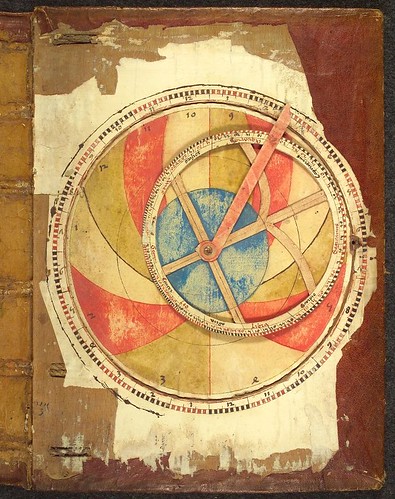
Schicksalsbuch - astrolabe
numinous things: astrolabe paper art...
"Numinous (pronounced /ˈnjuːmɨnəs/, from the Classical Latin numen) is an English adjective describing the power or presence of a divinity. The word was popularized in the early twentieth century by the German theologian Rudolf Otto in his influential book Das Heilige (1917; translated into English as The Idea of the Holy, 1923). According to Otto the numinous experience has two aspects: mysterium tremendum, which is the tendency to invoke fear and trembling; and mysterium fascinans, the tendency to attract, fascinate and compel. The numinous experience also has a personal quality to it, in that the person feels to be in communion with a Holy Other. The numinous experience can lead in different cases to belief in deities, the supernatural, the sacred, the holy, and the transcendent.

'Nostalgia for paradise' was a term also used by Mircea Eliade to help bring understanding to the numinous."

(Wikipedia)
Related Posts Plugin for WordPress, Blogger...